




Mission: To preserve the public’s health, welfare, and quality of life through effective, efficient, fiscally and environmentally responsible management of the County's mosquito populations and aquatic/exotic vegetation in accordance with Florida Statutes, Florida Administrative Code, and Best Management Practices.
For more information, please call the Public Works Mosquito & Aquatic Weed Control Division at 941.764.4370 mosquito: press 1 aquatics: press 2
Mosquito Control
Charlotte County Mosquito Control strives to control the mosquito populations through an integrated pest management approach consistent with applicable laws and justified by principles of public health, vector control, environmental safety, and fiscal responsibility.
Aquatic Weed Control
Aquatic weed control strives to keep invasive and noxious weeds from overrunning Florida's native vegetation thereby maintaining water conveyance, improving drainage, and reducing mosquito breeding habitats.
How does CCMAWC manage mosquito control?
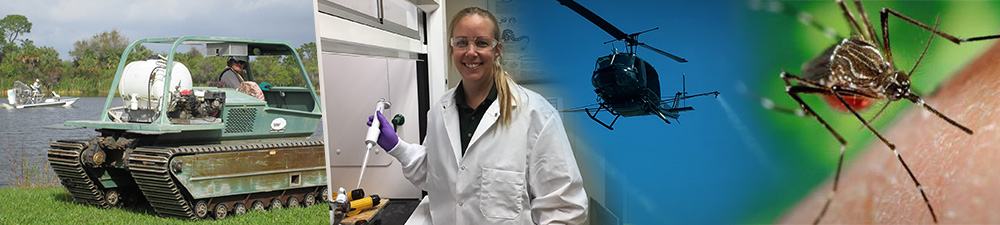
CCMAWC uses an integrated approach that includes prevention, source reduction, larviciding, and adulticiding. The most effective mosquito control starts with eliminating standing water where mosquitoes breed. Larviciding targets mosquitoes in their aquatic immature stages, while adulticiding targets flying adult mosquitoes only when needed.
Does CCMAWC follow a regular spraying schedule?
No. Mosquito treatments are not done on a pre-set schedule. Adult mosquito treatments are conducted only when surveillance data shows mosquito populations meet Florida state treatment thresholds or when disease is present.
How does CCMAWC decide when and where to treat?
Treatment decisions are based on daily surveillance, including trap counts, field inspections, landing rate counts, disease monitoring, sentinel chickens, mosquito pool testing, Department of Health guidance, weather conditions, and equipment or applicator availability.
Can residents request mosquito spraying?
Residents may submit service requests, and those requests help identify areas that may need inspection or monitoring. However, service requests do not automatically trigger spraying. Repeated requests do not increase the chances of treatment unless mosquito populations meet state treatment criteria or disease is present.
Why doesn’t mosquito control treat every area all the time?
Mosquito control is targeted rather than continuous. Treating only when data supports it helps reduce unnecessary pesticide use while maintaining effective mosquito control.
What is the difference between larviciding and adulticiding?
Larviciding treats mosquitoes before they become flying adults by targeting larvae in water. Adulticiding treats mosquitoes that are already flying and active, typically in the evening or at night.
Are aerial mosquito control treatments safe?
Yes. When performed by trained, licensed professionals using U.S. EPA-approved materials, aerial treatments are considered safe for people, pets, and the environment. Treatments are applied at night in very low doses and use precise technology to reduce environmental impact.
Why did the helicopter not spray directly over my house?
Modern aerial spray systems use onboard computers and real-time weather data to account for wind and droplet movement. The aircraft may release material from an offset location so the treatment reaches the intended target area.
How do adulticide trucks work?
Spray trucks are calibrated using a variable flow rate based on speed. Whether the truck is moving 10 mph or 20 mph, the application is adjusted proportionally. Trucks spray between 5 mph and 29 mph, and all operations are GPS-tracked and reviewed by supervisors.
Why do treatments sometimes seem like they are not working?
Adulticide products do not have a residual effect. If mosquitoes are not flying in the spray path during treatment, they may not be affected. New mosquitoes can also hatch and reinfest areas, especially during the peak season, which is why repeated treatments may be needed when thresholds are met.
What products are used, and who regulates mosquito control?
Mosquito control programs use U.S. EPA-approved products and must follow federal and state regulations. Applicators are licensed and trained, and products are used according to label requirements.
What happens during a mosquito control inspection?
A technician will knock and speak with the resident first. If invited, they will inspect the property for standing water and breeding areas, take mosquito landing rate counts, and leave a door hanger with findings. Treatments are only made when state-established thresholds are met and weather allows.
What are mosquitofish, and how can I request them?
Native mosquitofish, or Gambusia holbrooki, can eat mosquito larvae in appropriate water sources such as small ponds, rain barrels, or abandoned pools. Residents may submit a service request, and a technician will evaluate whether mosquitofish are suitable for the site.
How can I reduce mosquito activity around my home?
Remove standing water from buckets, birdbaths, gutters, old tires, plant containers, and similar items. Keep grass and shrubs trimmed, maintain window and door screens, use fans outdoors, and apply U.S. EPA-approved repellents when needed.
How are mosquito populations monitored?
CCMAWC monitors mosquito activity through traps, field inspections, landing rate counts, disease monitoring, and public feedback. The program also proactively samples designated areas throughout Charlotte County rather than only waiting for service calls.
Why do mosquito populations increase after rain or flooding?
Rain and flooding create standing water where mosquitoes can breed. Eggs can hatch quickly once flooded, and mosquitoes can reach adulthood in as little as 7 to 10 days.
Why are salt marsh mosquitoes so common in Southwest Florida?
Charlotte County has extensive salt marshes, coastline, estuaries, low-lying terrain, and a subtropical climate. These conditions make the area highly productive for mosquitoes. Salt marsh mosquitoes also develop quickly and can fly long distances, allowing them to reinfest neighborhoods after treatment.
Why do mosquitoes bite people?
Female mosquitoes bite because they need blood nutrients for egg development. Male mosquitoes do not bite. Both male and female mosquitoes also feed on nectar for energy.
How long do mosquitoes live?
Mosquito lifespan varies by species and conditions, but many adult mosquitoes live for several weeks. Warm temperatures and available water can increase survival and breeding.
Are some people more attractive to mosquitoes?
Yes. Mosquito attraction can be influenced by body odor, carbon dioxide output, body temperature, sweat, skin chemistry, and blood type.
What diseases can mosquitoes spread in Florida?
Some mosquito species can spread illnesses such as West Nile virus, dengue, eastern equine encephalitis, malaria, and other diseases. CCMAWC monitors mosquito-borne disease risk using tools such as sentinel chicken testing and mosquito pool testing.
What ecological role do mosquitoes serve?
Mosquitoes can serve as food for birds, bats, fish, and other wildlife. They may also assist with pollination while feeding on nectar.
Why don’t bat houses or purple martins solve mosquito problems?
Bats and purple martins eat insects, but mosquitoes make up only a small part of their diets. Many bats prefer larger insects, some mosquitoes are active when bats are not, and mosquito populations from productive breeding areas can exceed what predators alone can control.
Does CCMAWC manage insects other than mosquitoes?
CCMAWC focuses on mosquito-related health and nuisance issues. Adult mosquito treatments may incidentally reduce some other biting insects, but CCMAWC does not treat nuisance midges, love bugs, or no-see-ums.
Are new mosquito control technologies being considered?
|Yes. CCMAWC continues to evaluate new tools and approaches, including new trap types, diagnostic tools, pesticide treatments, and other emerging mosquito control technologies.
Address:
25550 Harbor View Rd. Ste 2
Port Charlotte, FL 33980